


How to solve compatibility issues when connecting PVC drainage pipes to pipes made of other materials?
Release Time : 2026-02-25
When connecting PVC drainage pipes to pipes of other materials, the core compatibility issue lies in the instability caused by differences in material properties. This requires a comprehensive solution encompassing connection methods, sealing design, selection of transition fittings, and construction specifications. Different pipe materials exhibit significant differences in their thermal expansion coefficients, elastic moduli, corrosion resistance, and other physicochemical properties. Direct connection can easily lead to leakage due to stress concentration, seal failure, or chemical corrosion. Therefore, targeted design is necessary to achieve reliable compatibility.
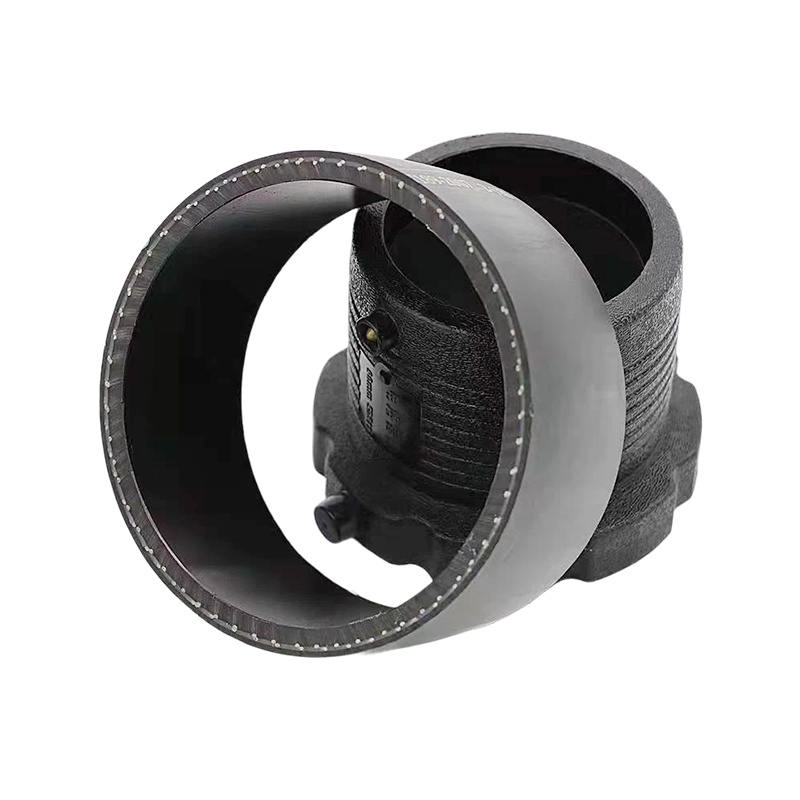
When connecting PVC drainage pipes to metal pipes (such as cast iron or steel pipes), the difference in material hardness and rigidity is the main challenge. Metal pipes have low surface roughness and are prone to oxidation and rust. Direct socket connections can easily loosen due to insufficient friction. The solution is to use specialized transition fittings, such as cast iron to PVC reducers. These fittings have a highly elastic rubber sealing ring embedded in their outer ring, forming a double seal through mechanical compression: the rubber ring fills the tiny gaps between the metal and plastic and absorbs vibration to prevent separation; the internal stepped groove design of the fitting creates an interference fit with the outer wall of the PVC pipe, enhancing connection strength. During installation, rust on metal pipe joints must be thoroughly removed, and neutral sealant applied to prevent electrochemical corrosion.
When connecting to plastic pipes (such as PP and PE pipes), insufficient adhesive compatibility due to differences in molecular structure is a key issue. PP pipes, due to their low surface energy, cannot form chemical bonds with PVC-specific adhesives; forced bonding will cause the joint to become brittle due to swelling. In this case, mechanical connection methods should be preferred, such as using an internal/external threaded connector: heat-melt the PVC pipe end to a PVC external threaded connector, and the PP pipe end to a PP internal threaded connector, then tighten the threads to achieve the connection. The threaded areas should be wrapped with PTFE tape or coated with anaerobic sealant to fill micro-gaps caused by processing errors and to withstand axial forces generated by water pressure fluctuations.
Connecting composite material pipes (such as steel-plastic composite pipes) requires consideration of the dual characteristics of both metal and plastic. Steel-plastic composite pipes have an outer layer of galvanized steel and an inner layer of PVC or PE plastic. Directly connecting to a PVC drainage pipe by only treating the outer metal layer can lead to delamination of the inner plastic layer. The correct procedure is to use a steel-plastic transition joint. One end is a press-fit metal connector, which is pressed into the outer steel pipe of the steel-plastic pipe; the other end is a socket-fit plastic connector, which is plugged into the drainage pipe using PVC adhesive. For the press-fit part, sufficient pressure must be applied using a specialized hydraulic tool to cause plastic deformation of the metal pipe wall, tightening the rubber sealing ring on the inner wall of the joint. For the socket part, the insertion depth must be controlled to ensure a uniform adhesive layer without air bubbles.
Connections under special conditions require enhanced sealing and seismic design. In seismically active areas or high-rise buildings, pipelines need to withstand lateral displacement caused by seismic waves or wind loads. In such cases, flexible connection solutions should be used, such as installing a rubber vibration damping joint between the PVC drainage pipe and the main metal pipe. This joint has flange structures at both ends, fixed to the pipes on both sides with bolts, and a high-strength rubber body in the middle, allowing a deflection angle of ±15° and axial displacement of 10mm, effectively absorbing vibration energy. A nylon reinforcement layer is embedded inside the rubber body to prevent excessive deformation caused by water pressure impact, and an anti-corrosion coating is sprayed on the outer layer to extend its service life.
Construction specifications significantly impact compatibility. When cutting PVC pipes, use specialized pipe cutters to ensure a vertical, burr-free cut, avoiding damage to the pipe ends and affecting the seal. Metal pipe ends must be chamfered with a file to remove sharp edges and prevent scratching the rubber seals. Before connection, thoroughly clean away oil and dust with a cleaning agent to ensure the sealing surfaces are dry and clean. For adhesive connections, maintain an ambient temperature between 5-40℃; low temperatures delay adhesive curing, while high temperatures accelerate solvent evaporation, leading to decreased bond strength. For mechanical connections, tighten bolts according to the manufacturer's recommended torque value to avoid leaks from excessive looseness or damage to the threads from excessive tightness.
Long-term maintenance is crucial for ensuring compatibility. Regularly inspect connections for leaks, deformation, or loosening, paying particular attention to the aging of rubber seals, which typically need replacement every 5 years. Metal components require rust prevention treatment every 2 years, applying rust-preventive paint or zinc oxide paste. Avoid hanging heavy objects on pipes or applying external impacts to prevent stress concentration and cracking at connections. For buried pipelines, inspection wells should be installed at connections for easy future maintenance and replacement.